Affichage des articles dont le libellé est histoire. Afficher tous les articles

vendredi 11 octobre 2013

80 ans du CVBS (Sharpie 9m2) / 80th anniversary of the Club (Sharpie 9m2)


2013, mon club le CVBS (Cercle de Voile des Boucles de la  Seine) a 80 ans. Nous voulions célébrer cet anniversaire en mai mais la Seine, en crue, nous l'a fait reporter. Il a été finalement été fêté en septembre, de façon plus simple
2013, my club the CVBS (Cercle de Voile des Boucles de la Seine) is 80 years old. We wanted to celebrate the anniversary in May but the Seine River flood made us cancel the event. It was finally rescheduled in September, on a smaller scale than previously thought.


Pierre Toureau, notre président d'honneur, est le seul membre du Club a l'avoir été continument depuis 1933. Le voici en train de nous faire un discours sur l'histoire du club, d'abord situé à Chatou puis, pour cause de proximité trop grande avec une usine de roulements à billes que les Alliés tenaient vraiment à faire cesser sa production à coup de bombes, déménagé à Montesson en 1942.
Pierre Toureau, our honorary president, is the only member of our club that has renewed his membership every year since 1933. Here he is retelling the story of the Club, first located in Chatou, then, because it was to uncomfortably close to a ball-bearing factory that the Allied wanted to close down using air raids, moved to Montesson in 1942.


Pour mettre l'accent sur la longue histoire de notre club, nous avons décider de faire naviguer nos 3 plus vieux dériveurs, à savoir mon Dinghy 12' International, le Plongeon qui a été restauré par Sequana et un Sharpie 9m2 qui appartient aux réserves du CVBS (l'épave à gauche ne navigue PAS)
To emphasize our club’s long history, we decided to sail our 3 oldest dinghies, meaning my International Dinghy 12’, the Plongeon that was restored by Sequana and a Sharpie 9m2 that belongs to the CVBS reserves (the junk on the left does NOT sail)


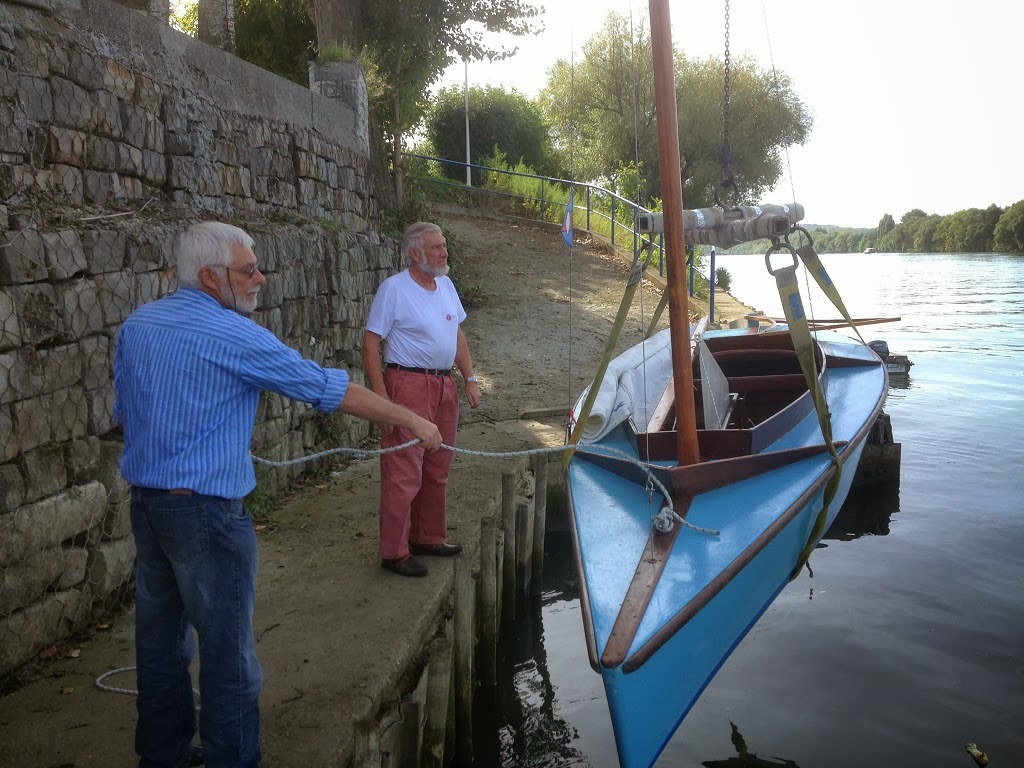
Comme disent les chinois, 安全第一! (la sécurité avant tout !) donc nous avons d'abord gruté notre sécu suffisamment tôt pour que sa coque gonfle et limite les fuites. Jetez un coup d'oeil sur son moteur ultra-moderne, ce n'est pas une machine à vapeur comme à Séquana mais bien un moteur à combustion interne des plus récents.
As the Chinese say: 安全第一! (Safety first!) so we lowered our safety boat in the Seine waters early enough for its hull planks to swell and limit the leaks. Check the brand new engine, not an old steam machine like Sequana’s, it’s a modern internal combustion engine.


Le Dinghy 12' International vous est maintenant familier, j'ai fait un article sur le Plongeon ici mais connaissez vous le Sharpie 9m2 au nom si peu français ?

The Dinghy 12’ is well known to you now,  I made another article about the Plongeon here. But do you know the Sharpie 9m2, a French dinghy with a foreign name ?

Type/type:                     dériveur régate / racing dinghy
Année/year:                   1937
Architecte/designer:        Stampfli + Herbulot
Longueur/length:             5.0m / 16'5''
Flottaison/water line:       4.58m / 15'
Maitre bau/beam:            1.44m / 4'9''
Tirant d'eau/draft:             0.11-1.10 / 4''-3'7''
Surface vélique/sail area: 9m2 / 97 sqf
Poids / weight:                 185 kg/ 408 lbs


C'est un bateau bizarre mais mignon dans son genre. On peut noter sa tonture inversée et son immense barre triangulaire qui évite d'y ajouter un stick. On peut voir sur l'hiloire les 2 sièges pour faire du rappel.
It’s a weird looking boat, quite cute in its own way. Of note is its reverse sheer line and its tiller’s triangular shape that enables you to forfeit a tiller extension.You can see along the coaming the 2 hiking seats.


Il y a un article sur wikipedia ici:/There is a French article on wikipedia here:
http://fr.wikipedia.org/wiki/Sharpie_9_m2


Bien sur, Plongeon et Dinghy ont aussi navigué
Of course, the Plongeon and the Dinghy 12' also sailed


Honte à moi, le vent était très faible et c'est moi en dinghy qui ait dérivé le plus vite vers Maisons-Laffitte quand le Plongeon et le Sharpie arrivaient mieux que moi à se maintenir et remontaient mieux au vent...
Shame on me, the wind was very weak and it's me in the Dinghy 12' that was taken the fastest by the current towards Maisons-Laffitte while the Sharpie and the Plongeon fought better against the current and could sail closer hauled than me... 


Une belle journée néanmoins / a great day nevertheless 

mercredi 12 juin 2013

Lac des Settons 1 / Les Settons Lake 1

Après plusieurs traversées sans histoires de la Seine à Montesson, j'ai commencé à songer à de nouveaux défis et à rêver d'océans. Quelle mer choisir ? En France ça ne manque pas...

 After several succesful crossings of the Seine River in Montesson, I was getting ready for new challenges and dreaming of open seas. Which coast would I choose? Plenty of them in france


Eh bien, ma famille a une maison en Bourgogne dans le Morvan, au milieu duquel il y a le Lac des Settons

Well, my family has a foothold in Burgundy (=Bourgogne), in the Morvan area, and in the middle of Morvan lies a Lake: Les Settons.


Le barrage de ce lac artificiel a été construit en 1858 pour aider au flottage du bois de chauffage en direction de Paris. On y stockait l'eau de la Cure et au printemps, on "tirait la chasse" qui emmenait les grumes vers la Seine. Au milieu des années 20, le charbon a tué cette activité

This lake had a practical purpose when built in 1858: storage water of the Cure river in order to float wood towards Paris burnt for heating. Basically, they were flushing the logs in spring. This went on until the mid-twenties when cheap coal killed the industry


Altitude: 586 mètres (gare au gonflage des Réserves de flottabilité du Dinghy quand on vient de Paris à 26 mètres!!!)
Surface: 366 hectares
2 iles
2 cales


Altitude: 586 meters (beware of bursting your inflatable buoyancy bags when you drive from Paris that lies at 26 meters!)
Area: 366 ha = 904 acres
2 islands
2 slipways


Peu de vent ce jour là, mais un grand bonheur à naviguer avec mon fils.
Not much wind that day, but lots of fun sailing with my son

lundi 3 juin 2013

la génèse de mon dinghy / my dinghy origins

Trouvé dans un livre hollandais de 2006 dont Steve Crook m'a scanné quelques pages, merci google pour la traduc:

D’après le journal du chantier De Vlijt (“l’industrieux”) pour les années 1941-42, c’est entre septembre 1942 et janvier 1943 que les ouvriers commencèrent la construction de la commande 427. Ce numéro correspondait à une série de trois dinghy 12’, deux en chêne et un en acajou.
Entre le 24 et 30 avril, les bateaux étaient prêts. 6 mois s’écoulèrent avant le réception du paiement.

Couts:
Pour la construction de ces 3 dinghies, la main d’oeuvre s’éleva
à 414,82 florins. Jan Berkelaar,  charpentier  expérimenté de 42 ans, gagnait 0,64 florins de l’heure.
Le voilier C. Hali, d’Aalsmeer fournit deux voiles au prix de 57,80 florins par bateau. Les mats venaient de Van der Neut, d’Alphen aan den Rijn au prix de 166 florins.
La peinture a couté 200 florins et le bois 880. Avec les autres fournitures, le cout total des matériaux s’éleva à 1814,58 florins.
Le cout total des ces 3 dinghies fut donc de 2229.40 florins, soit 743 par bateau.

Trois numéros, trois propriétaires
Les 3 dinghies furent jaugés en 1943, probablement au chantier et ainsi les données des trois furent préservées. Les numéros de voile qu’ils reçurent furent 469, 471 et 472.

Numéro 469
J. Peters, de Sloten, paya De Vlijt le 31 octobre 1943 pour le dinghy de chêne qu’ils avaient fabriqué entre septembre 1942 et avril 1943. Le bateau lui couta 750 florins (340 EUR) et le certificat de jauge 15,82 florins (7,18 EUR). Son numéro de voile était 469 et son nom d’origine « Stofhater » (« déteste la poussière »). Ce dinghy existe toujours.

Numéro 471
H.A. Burgerhout Jr.. de La Haye paya 950 florins en septembre 1943 pour son dinghy en acajou. Il a lui aussi été jaugé en 1943 et reçu le numéro 471. Baptisé « Corelis Cornelisz Jol » (un corsaire du 17ème siècle, dont le nom Jol signifie aussi… dinghy) rien n’est plus connu de sa carrière.

numéro 472
JCJ Ouwehand d’Amsterdam acheta le 3ème dinghy de la série. Il était en chêne et d’après le registre du chantier, il a couté 802 florins, gréement compris.  Baptisé « thejopie », il a été jaugé en 1943 et reçu le numéro 472. Le registre hollandais des Dinghy 12’ mentionne qu’il a été réquisitionné durant la guerre mais il l’a heureusement traversé sans dommage car on retrouve la trace de son rachat en 1951 par M. EJ Volkers, d’Amsterdam. Il l’a rebaptisé « Jolkert » puis on perd sa trace…

Found in a dutch book dated 2006 by Steve Crook who scanned a few pages, thanks Google for the translation:


According to the De Vlijt (“The industrious”) Aalsmeer Shipyard logbook 1941-1942, Jan Berkelaar, boat builder, started working on order  427 in September 1942. This consisted of a series of three 12’ dinghies, two were of oak and one of mahogany.
In April 1943, the boats were ready for delivery. Between the ready date and the date of payment was a period of almost half a year.


Cost
For the construction of these three dinghies, the labor costs amounted to a total of 414.82 f. The 42 year old and very experienced boat builder Jan Berkelaar earned at that time an hourly rate of 0.64 f
The sail maker C. Hali from Aalsmeer provided the rig for two of the 12’ for f 57.80 each. The masts came from Van der Neut,  from Alphen aan Rijn, at the cost of 166 f.
Paint was listed at f 200 and wood at f 880. Along with a few other items, the total material costs amounted to f 1814.58
The cost for these three dinghies was thus f 2229.40. Per boat f 743 (= EUR 337, or USD 450)

Three dinghy numbers, three owners
As described above, order 427 consisted of three 12 foot dinghies. All three were measured in 1943, probably in the yard, and thus the three dinghies’ data can still be seen. The numbers they received were: 469, 471 and 472.

Sail number 469
J. Peters of Sloten (NH) paid the "De Vlijt" shipyard on October 31st , 1943 for the oak dinghy that they had built between September 1942 and April 1943. The 12-foot dinghy cost him 750 f, the measurement certificate f 15.82. The  number of the dinghy was 469 and its name " Stofhater” (= Dust Hater). This 12-foot dinghy still exists.

Sail number 471
H.A. Burgerhout Jr.. from The Hague paid for his 12-foot mahogany dinghy f 950 in September 1943. The ship was also measured in 1943 and was number 471. The name of this 12-foot dinghy was " Corelis Cornelisz Jol “ (the name of a 17th century corsair whose family name “Jol” means also… dinghy). Of this dinghy nothing more is known.

Sail number 472
JCJ Ouwehand from Amsterdam bought the third dinghy of this series. According to the data of March 31, 1943, she was made of oak and cost f 802, including rigging. The measurement certificate was also drafted in 1943 and received number 472. Her name was “thejopie” The Dutch International 12’ Dinghies registry states that this boat was requisitioned during the war but fortunately it survived it, because it was sold to its new owner, EJ Volkers from Amsterdam in 1951. The 12’ was renamed: "Jolkert" then it also vanished from further records…


dimanche 2 juin 2013

Nom et immatriculation 1 / name and sail number 1

Travaux du jour: changer le nom de mon bateau et son numéro de voile.

Pour le numéro, c'est une demande de la Classe Dinghy France http://dinghy.fr/ qui souhaite que ses membres arborent les numéros français plutôt que les numéros italiens ou hollandais originaux.

Je passe ainsi de NED 469 à FRA 38

Du coup, je me suis dit que si le numéro devait changer, lui qui a une réelle valeur historique, autant changer le nom en même temps.

le nom de 2010
Pour le nom, j'ai du poncer le tableau presque jusqu'au bois (que j'ai atteint par endroits) pour retirer la peinture.


Le nom d'origine, De Bonte Koe signifie "la vache bigarrée" en hollandais, il y a des marques de chocolats, des cafés, etc qui portent ce nom.


Mais Bontekoe est aussi le nom d'un marin hollandais historique qui a subi un lot d'infortunes extraordinaire, perdant plusieurs bateaux coulés sous lui et la plupart de ses compagnons http://fr.wikipedia.org/wiki/Willem_IJsbrantsz._Bontekoe


Un peu comme si mon bateau s'appelait Sinbad ou Ulysse + Vache Qui Rit en même temps.

Ce nom a d'ailleurs changé plusieurs fois depuis la construction de mon bateau, voici la liste, ainsi que de ses proprios et de ses ports d'attache:

Year  Boat name      Owner                    Location
1943  Stofhater          H.A.J. Peters           Sloten
1944  Stofhater         C.M. Kriens             Den Haag
1975  V.I.P.               F.H.M. Daniels         Leidschendam
1976  La Robleda      D. Sluyk                   Den Haag
1991  La Robleda      D. Nolles                 Haarlem
1992  La Robleda       L.B.G. Strijbos       Zaandam
1993  De Bonte Koe  W.M.J.M. Meyer    Leiden
1998  De Bonte Koe  J.Weterings              Den Haag
2003  De Bonte Koe  C.J.A.M. de Groot  Houten
2010  De Bonte Koe  R. Berard                Le Pecq (France)

Quick English translation: The French Dinghy Association would like us members to show our French numbers on our sails for a change instead of the original Dutch or Italian ones. I agreed to do so, I will change from NED469 to FRA38. A number being much more attached to a boat than its name, I decided to change the name as well. De bonte koe meant "the motley cow" and was also the name of a famous unfortunate Dutch sailor of the 17th century.

I sanded the transom until I reached the wood in places to remove the old painted name